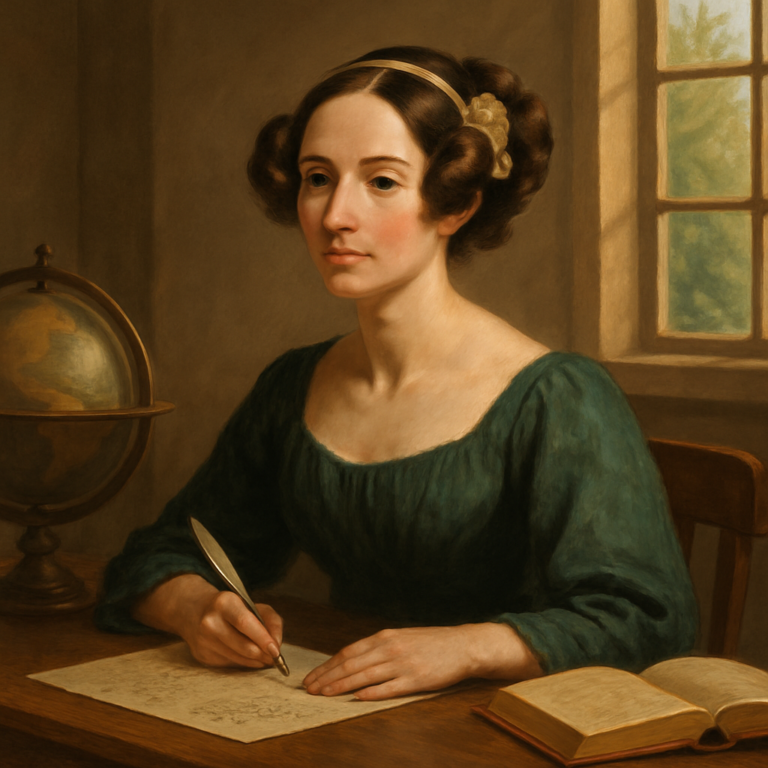
1815–1852
Ada Lovelace
Connects mathematics, imagination, symbolic systems, computation, and the creative potential of machines.
Computing · Feminist Thought · Mathematics

Discover philosophers, scientists, mathematicians, psychologists and visionaries. Read their work, understand their influence and continue the conversation through AI.

Connects pragmatism, psychology, religion, emotion, habit, attention, and lived experience in practical inquiry.
“My experience is what I agree to attend to.”
Connects mathematics, imagination, symbolic systems, computation, and the creative potential of machines.
Investigates computation, intelligence, logic, codebreaking, algorithms, and the boundaries of machine thought.
Reflects on absurdity, revolt, mortality, dignity, freedom, and living meaningfully without false certainty.
Explores relativity, imagination, physical intuition, spacetime, scientific humility, and the elegance of deep principles.
Analyzes logic, virtue, causality, nature, politics, and practical wisdom through systematic classification and balanced reasoning.
Explores God or Nature, freedom, emotion, ethics, necessity, and human flourishing through geometric reasoning.
Clarifies logic, language, mathematics, skepticism, ethics, peace, and public reason with analytical precision.
Balances mathematics, probability, faith, human fragility, decision, risk, and the drama of the heart and reason.
Guides reflection on suffering, impermanence, craving, compassion, attention, and liberation from reactive patterns.
Explores archetypes, symbols, individuation, dreams, myth, shadow, and psychological integration.
Explains adaptation, natural selection, variation, descent, and careful observation of life’s branching patterns.
Develops pragmatism, signs, inquiry, fallibilism, logic, and scientific reasoning as communal truth-seeking.
Offers guidance on virtue, ritual, family, leadership, education, and social harmony through moral cultivation and humane conduct.
Challenges certainty through skepticism, habit, causation, emotion, morality, religion, and human nature.
Builds rigorous geometric reasoning from definitions, axioms, proofs, and step-by-step demonstration.
Examines colonialism, identity, violence, liberation, psychology, race, and the wounds of domination.
Challenges morality, truth, herd thinking, nihilism, self-overcoming, art, and life-affirming transformation.
Champions observation, experiment, mathematics, and intellectual courage in understanding motion and the cosmos.
Interprets history, consciousness, contradiction, freedom, and social institutions through dialectical development.
Explores calculus, logic, metaphysics, possible worlds, monads, optimism, and symbolic reasoning.
Explores power, action, responsibility, totalitarianism, judgment, plurality, and public life.
Represents mathematical clarity, philosophical teaching, astronomy, and intellectual courage in late ancient Alexandria.
Defends reason, interpretation, law, and philosophical inquiry while clarifying Aristotle’s influence in Islamic and European thought.
Connects metaphysics, medicine, logic, psychology, and the nature of being through rigorous Islamic Golden Age reasoning.
Move from a person to an argument, a school, or a live exchange without leaving the archive.
You will leave your account area, but your saved helpers, plans, workouts, and credits stay tucked into your profile.